


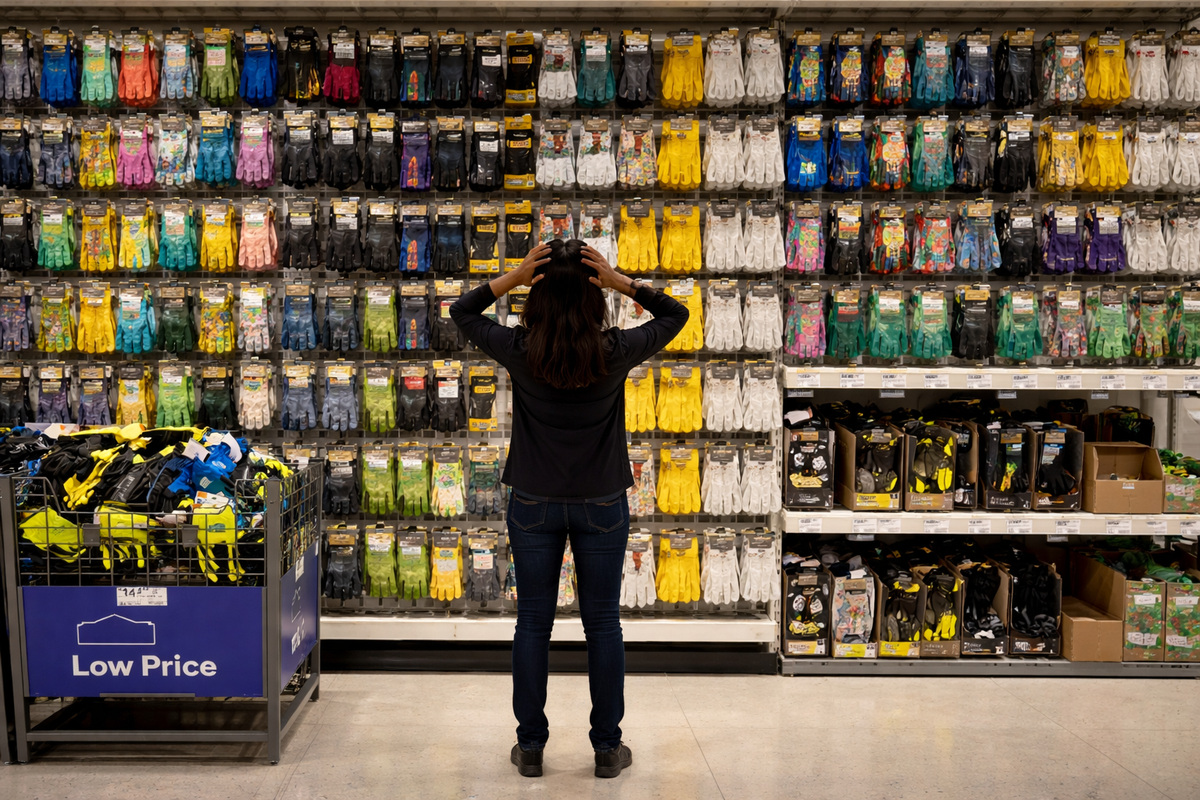
why the cheapest gardening glove is the most expensive choice the planet makes
Every spring I watch it happen — at hardware stores, at garden centers, in the checkout line at Target. A six-pack of nitrile gloves for $9.99. It feels responsible. Even thrifty. You're not being precious about it. You're just gardening.
Here's what doesn't make the hang tag: conventional synthetic gloves can take up to 100–200 years to fully break down in a landfill. The pair you tossed last October is still there. So is the one from the year before.
I didn't start higarden to lecture anyone. I started it because I spent twenty-five years watching Foxgloves make gloves that lasted — actually lasted — and couldn't understand why the rest of the industry was selling women something designed to fall apart.

the six-pack math
A committed gardener replacing one six-pack a year accumulates 60 pairs over a decade. Each pair can take up to 200 years to fully degrade under typical landfill conditions — which are, by design, hostile to decomposition. Landfills are compacted, oxygen-poor, and low in moisture and light. Things don't rot there. They wait.
Now multiply that by the 55 million American households that garden. The math becomes its own argument — and no single pair of gloves is doing it alone.
 This is not about one pair of gloves. It never is. According to the EPA's most recent data, 146.1 million tons of municipal solid waste were landfilled in a single year in the United States. Gardening gloves are a small fraction of that number. The habit behind them is not.
"one pair won't hurt" is how landfills fill up
I understand the logic. My pair won't matter. Except that logic, multiplied across millions of gardeners making the same calculation, is exactly how we ended up here.
The disposable glove isn't a product failure. It's a feature. Mass-market gloves are priced and built to be replaced every year, so those companies take more of your money every year. The business model depends on it. higarden's doesn't (we hope you'll gift them to others once you love em).
the ten-year glove
higarden gloves are made from Supplex nylon and Lycra, they are a synthetic fiber; which is exactly what makes them so durable. Lab certified UPF 50+ (blocks 98% UV rays), machine washable, built for repeated hard use. The oldest pair I know of still in active rotation belongs to Willa H. of Hillsdale, NY. It is over ten years old.
One pair over a decade versus sixty pairs in a landfill. It's arithmetic.

i won't oversell it
higarden is not a zero-waste company. Gloves will eventually wear out and need to be disposed of. I'm not going to pretend otherwise, because the gardening industry has spent long enough telling women what they want to hear.
What I can say is this: fewer units purchased means fewer units discarded. A product built to last is the sustainability claim we make. That, and 99% plastic-free packaging.
The gardener who tends her garden carefully deserves a glove that takes care of her. So does the earth she's standing on.
citations & sources
1. https://www.epa.gov/facts-and-figures-about-materials-waste-and-recycling/national-overview-facts-and-figures-materials
2. https://garden.org/special/pdf/2014-NGA-Garden-to-Table.pdf
3. https://earthsafeppe.com/how-to-dispose-of-nitrile-gloves
Share: